Architecture
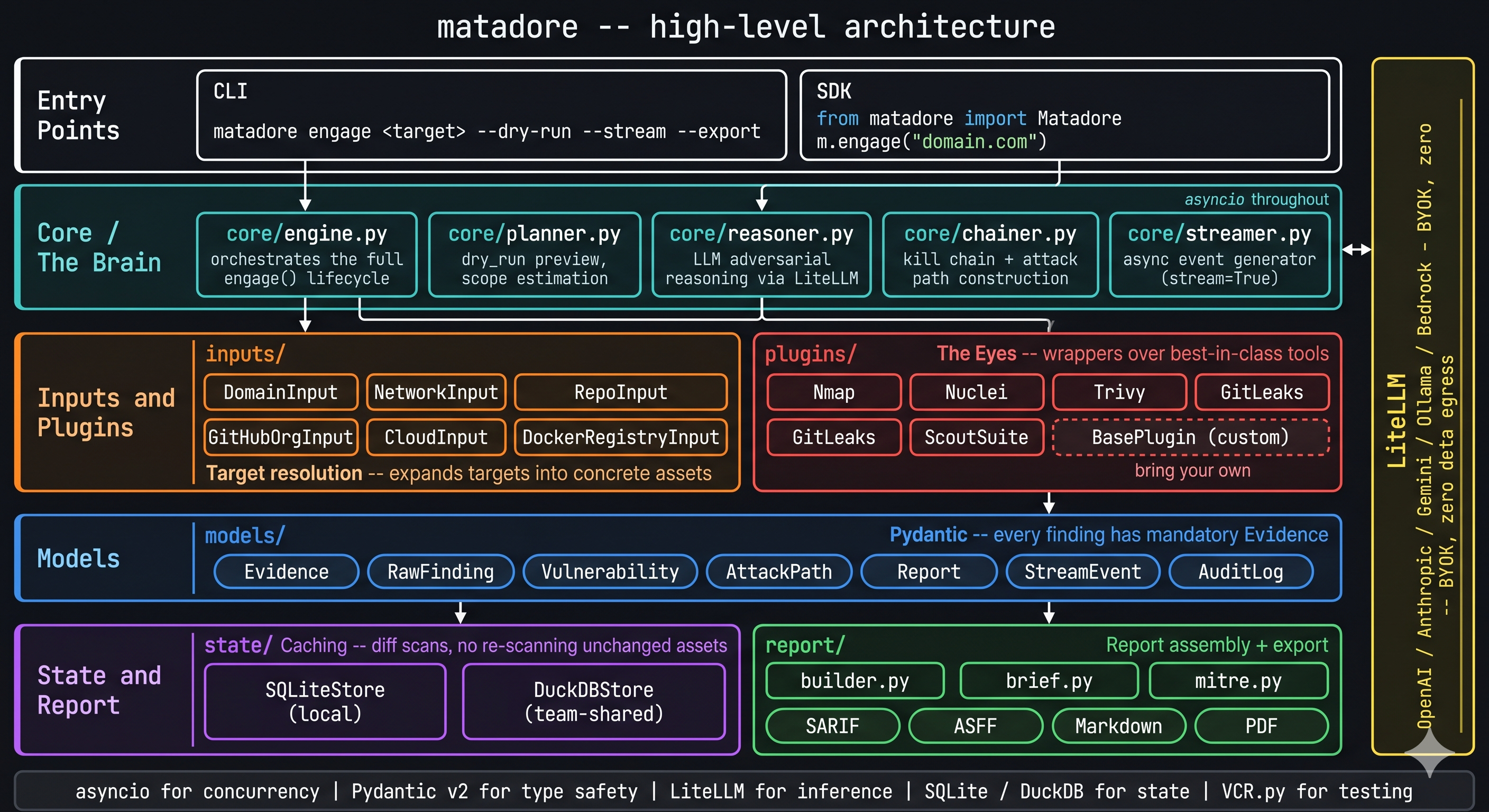
Overview
Matadore is structured in five distinct layers:
| Layer | Package | Responsibility |
|---|---|---|
| Entry points | cli.py, __init__.py |
CLI and SDK surface |
| Core / Brain | core/ |
Orchestration, LLM reasoning, kill chain construction |
| Inputs | inputs/ |
Expand targets into concrete scannable assets |
| Plugins | plugins/ |
Wrappers over best-in-class scanning tools |
| Models | models/ |
Typed Pydantic domain objects with mandatory Evidence |
| State | state/ |
Caching and diff scanning (SQLite / DuckDB) |
| Report | report/ |
Assembly, narrative brief, and multi-format export |
Core -- The Brain
The core/ package drives the full engagement lifecycle:
engine.py-- top-levelengage()orchestrationplanner.py--dry_run=Truescope previewreasoner.py-- LLM-powered adversarial analysis via LiteLLMchainer.py-- kill chain and attack path constructionstreamer.py-- async event generator forstream=Truemode
asyncio is used throughout the mapping phase so 100 IPs scan in parallel, not in sequence.
Plugins -- The Eyes
Matadore does not re-implement what nmap, nuclei, and trivy already do well -- it reasons over their output.
| Plugin | Tool | Target types |
|---|---|---|
Nmap |
nmap | domain, network |
Nuclei |
projectdiscovery/nuclei | domain, network |
Trivy |
aquasecurity/trivy | docker_registry, repo |
GitLeaks |
gitleaks | repo, github_org |
ScoutSuite |
nccgroup/ScoutSuite | cloud |
Extend with your own scanner by subclassing BasePlugin.
State and Caching
| Backend | Package | Best for |
|---|---|---|
SQLiteStore |
stdlib only | Local single-user engagements |
DuckDBStore |
requires pip install duckdb |
Team-shared, persistent across operators |
Matadore caches AssetSnapshot records keyed by (engagement_id, asset).
On repeated scans only assets whose checksum changed are re-processed.
Domain Model
See the Domain Models page for the full Pydantic model diagram.